
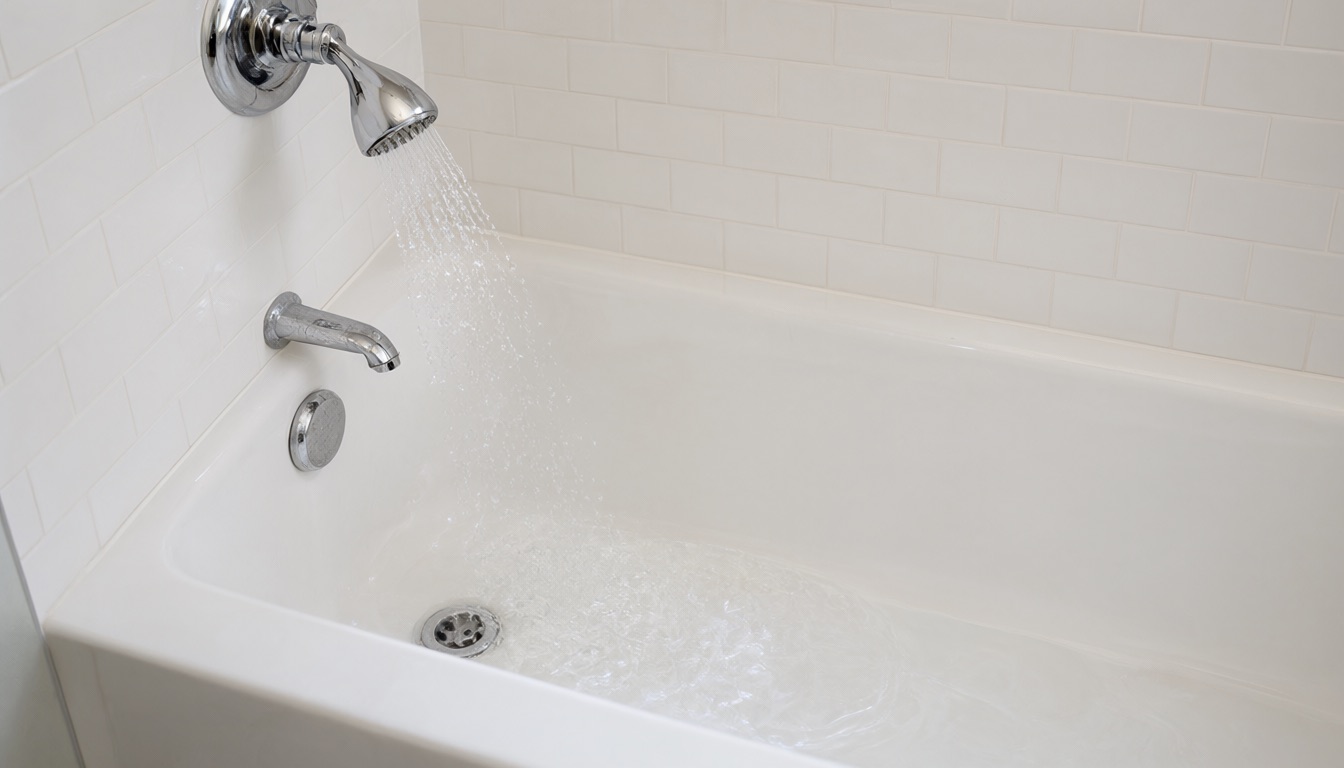
A bathtub that drains slowly only when the shower is running almost always has a partial clog, a stopper that doesn’t open fully, or more water coming out of the showerhead than the drain can carry. When you drain a full bath, the weight of all that water pushes it through a narrowed pipe, so the problem hides. A shower is different: it pours in a steady 2 gallons or so every minute, and if the drain can’t move that much, the water backs up around your feet. The good news is that most cases are a hair clog within a foot of the drain opening, and you can clear it yourself in under an hour.
Why does my bathtub drain slowly only when the shower is running?
Think of the drain as a pipe with a maximum speed. A clean 1½-inch tub drain can easily carry what a normal showerhead puts out. Once hair and soap scum narrow that pipe, its capacity drops, and at some point it falls below the shower’s flow rate. From then on, water comes in faster than it can leave, so it pools in the tub while you shower.
When you drain a full bath, two things hide the problem. First, 10 to 12 inches of water press down on the drain and force water through the narrowed spot faster. Second, nobody stands there watching a bath drain. You only notice a slow drain when you’re standing in it.
So “only when the shower is running” is not a separate fault. It’s usually the earliest warning sign of an ordinary slow drain. If you deal with it now, it’s a quick fix. If you leave it, the same clog usually gets worse until the tub drains slowly every time.
What causes a slow bathtub drain when the shower is on?
These are the usual causes, roughly from most to least common:
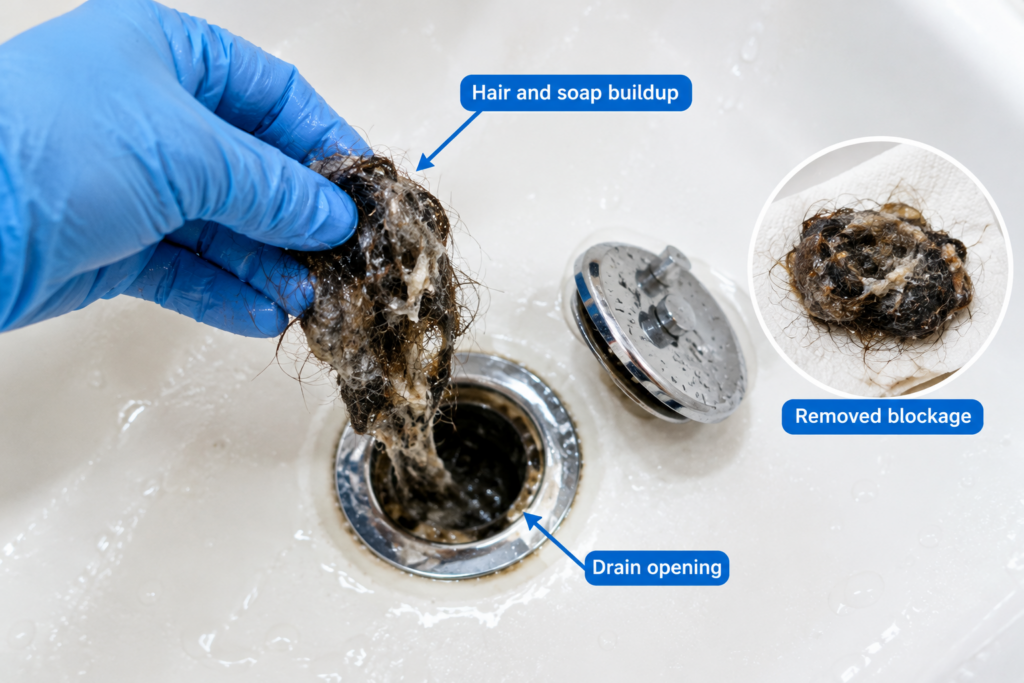
- Hair and soap scum caught at the stopper or crossbars. This is the cause in most homes. Hair wraps around the stopper post or the plunger in the overflow tube, and soap scum glues it into a mat.
- A stopper that doesn’t lift high enough. A loose lift-and-turn stopper, a sticky toe-touch stopper, or a trip-lever linkage that has slipped can leave the drain only partly open, even with the lever set to “open.”
- A showerhead that puts out more than the drain can handle. Rain shower heads, dual heads, body sprays, or a head with its flow restrictor taken out can send more water into a tub than a 1½-inch drain was designed for.
- A clog further down the line. Buildup in the trap or the branch pipe slows the whole drain, not just the opening.
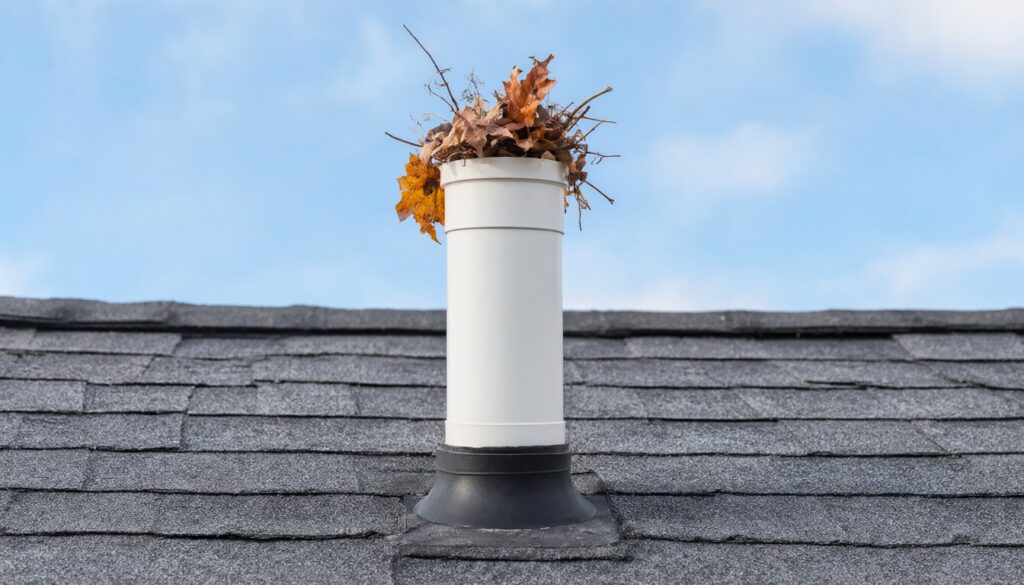
- A blocked plumbing vent. Drains need air behind the water to flow freely. If the vent pipe on the roof is blocked, the tub drains slowly and gurgles.
- A main sewer line problem or a badly sloped pipe. These are less common. They usually show up as several slow drains at once, or a tub that has drained slowly ever since a remodel.
How to diagnose a slow tub drain in 5 minutes
Before you buy anything, run these quick checks. Together they tell you which fix to try first.
- Look at the drain while the shower runs. Run the shower at full flow with the stopper open for 1 to 2 minutes. If water rises steadily, the drain can’t keep up. If it pools briefly and then holds a steady level, the drain is only slightly restricted.
- Check that the stopper is really open. Look at how high it sits above the drain. A stopper that rises only a few millimeters is a restriction in itself.
- Listen. Gurgling or glugging as the tub drains points toward a vent or a deeper clog, not just hair at the top.
- Test the other drains. Run the bathroom sink and flush the toilet. If they’re slow too, or water rises in the tub when you flush, the problem is in a shared pipe or the main line, not the tub.
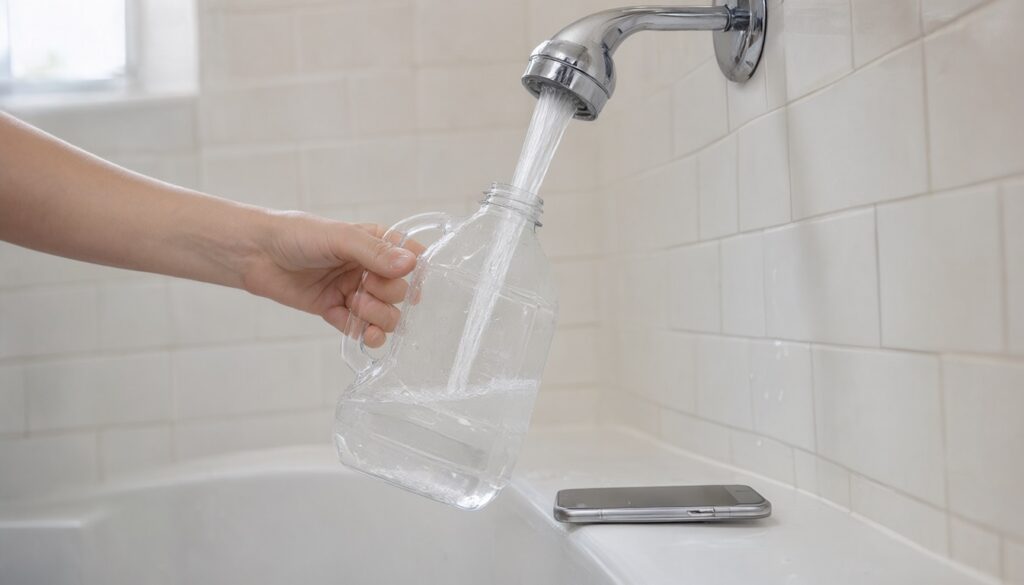
- Measure your showerhead. Hold a 1-gallon bucket or jug under the showerhead at full flow and time how long it takes to fill. Divide 60 by the seconds to get gallons per minute. Under 24 seconds means more than 2.5 gallons per minute.
Symptom and cause: a quick troubleshooting table
| What you notice | Likely cause | Fix to try first |
|---|---|---|
| Water pools while showering but a full bath still empties | Partial hair clog at the stopper or overflow plunger | Pull the stopper and remove hair (Step 1–3) |
| Stopper sits low even when the lever says “open” | Loose stopper or slipped trip-lever linkage | Adjust or replace the stopper (Step 4) |
| Drain was fine until you installed a new showerhead | Showerhead flow higher than the drain can carry | Measure the flow; use a 2.0 gpm or lower head |
| Still slow after clearing the visible hair | Clog in the trap or branch pipe | Plunge with the overflow covered, then snake (Steps 5–6) |
| Gurgling, a sewer smell, and slow drains in more than one fixture | Blocked vent pipe | Check the roof vent or call a plumber |
| Tub water rises when you flush the toilet or run the washer | Partial blockage in the main sewer line | Call a plumber for a main-line cleaning |
| Tub has drained slowly ever since a remodel | Pipe sloped too little, or a sag in the line | Have a plumber inspect the drain run |
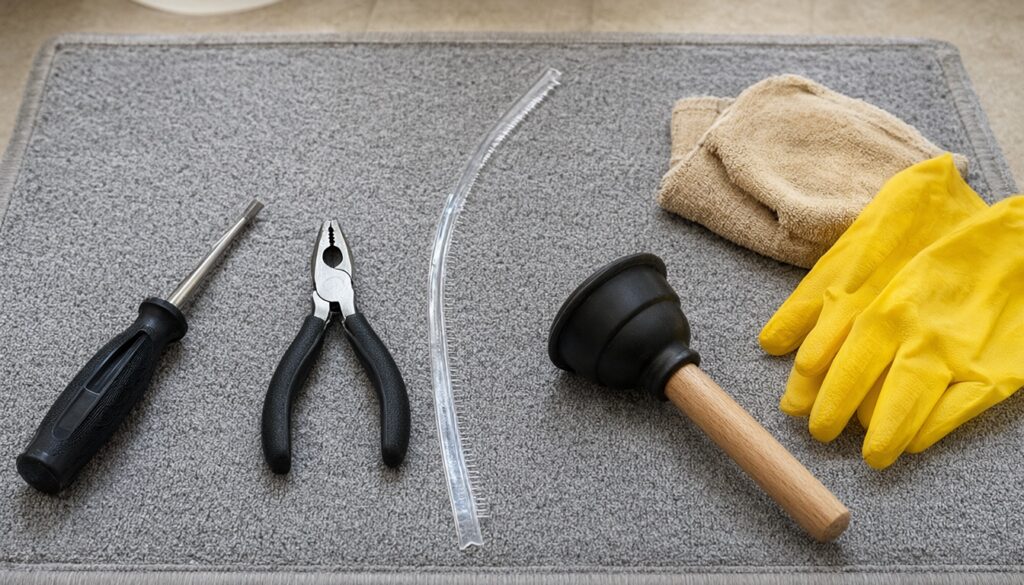
What you need
- Screwdriver (flat and Phillips) for the overflow plate and stopper screw
- Needle-nose pliers
- Plastic barbed drain cleaning strip
- Cup plunger (the flat kind, not the flanged toilet plunger)
- Old rag or washcloth to block the overflow opening
- Small hand drain auger (a ¼-inch drain snake), if the clog is deeper
- Rubber gloves, an old toothbrush and a bucket
- A 1-gallon jug and a phone timer for the flow test
How to fix a slow bathtub drain, step by step
Start at the top of the drain and work down. Most people never need to go past step 3.
Step 1: Identify your stopper type
How you get to the clog depends on the stopper. Most tubs have one of these:
- Lift-and-turn: a knob on top that you lift and twist. Hold the body and unscrew the knob, then unscrew the stopper itself.
- Toe-touch (foot-actuated): you press it with your foot. Unscrew the cap counterclockwise to reach a screw or post underneath, then remove that.
- Push-pull: you pull the knob up. It unscrews counterclockwise like a lift-and-turn.
- Trip lever with a pop-up stopper: a lever on the overflow plate moves a visible stopper in the drain. Pull the stopper straight up and wiggle its rocker arm out.
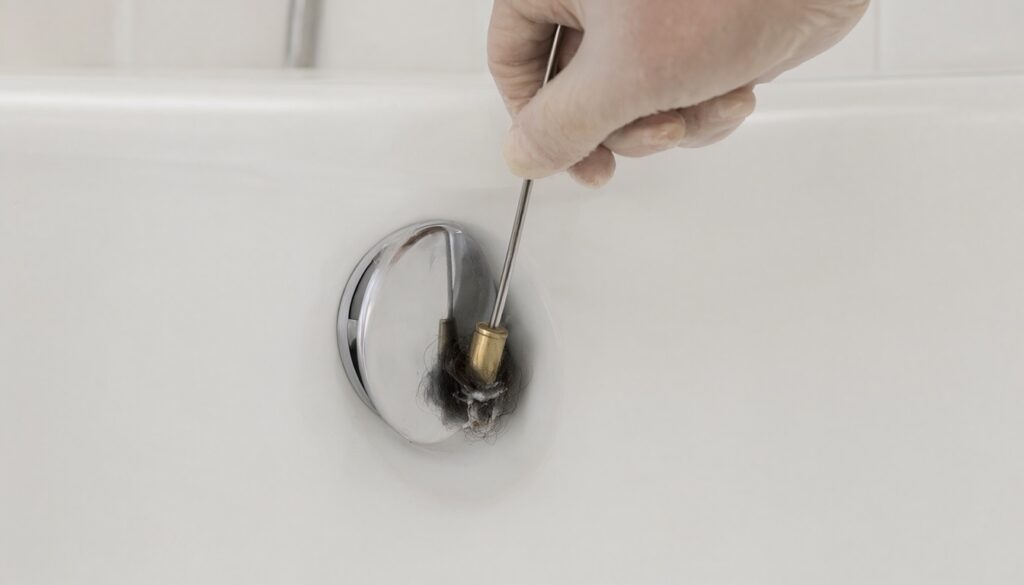
- Trip lever with a hidden plunger: a lever on the overflow plate, but only a grate in the drain. The “stopper” is a brass plunger inside the overflow pipe that drops down to block the water.
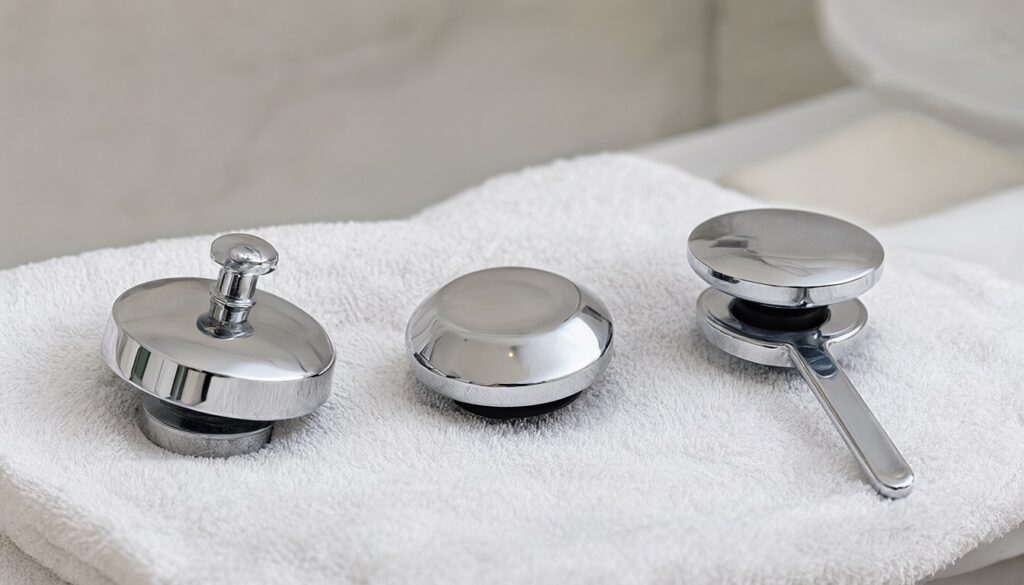
Step 2: Remove the stopper and pull out the hair
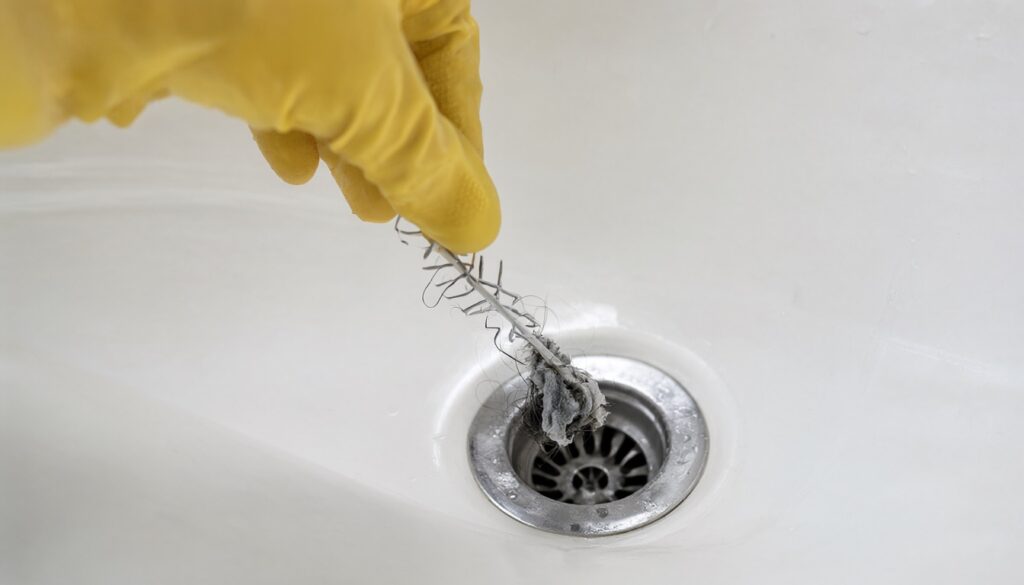
Take out the stopper and clean every bit of hair and slime off it with gloves and an old toothbrush. Then push a plastic barbed drain strip down the drain, twist it, and pull it out slowly. Repeat until it comes up clean. It’s not pleasant, but this one step solves the problem for many tubs.
If your drain has crossbars under the stopper, hair often wraps around them. Hook it out with needle-nose pliers.
Step 3: Clean the trip-lever linkage (if you have one)
For either trip-lever type, remove the two screws on the overflow plate and lift the plate, lever and linkage out of the overflow opening slowly. On a hidden-plunger drain, the brass plunger at the bottom of the linkage often comes out wrapped in hair. Clean it, then reinstall it.
Now run the shower again with the drain open. If the water no longer pools, you’re done.
Step 4: Adjust the stopper so it opens fully
A clean drain can still be slow if the stopper doesn’t lift high enough. On a lift-and-turn or toe-touch stopper, tighten the post into the crossbar until the stopper opens fully but still seals when closed. On a trip-lever drain, the linkage has a threaded rod and lock nut. Shortening it lifts a hidden plunger higher out of the water path, and lengthening it lets a pop-up stopper rise more. Adjust in small steps and test the seal each time by filling a few inches of water.
If the stopper is corroded or the threads are stripped, replace it. Universal replacement stoppers are sold at hardware stores. Take the old one with you to match the thread.
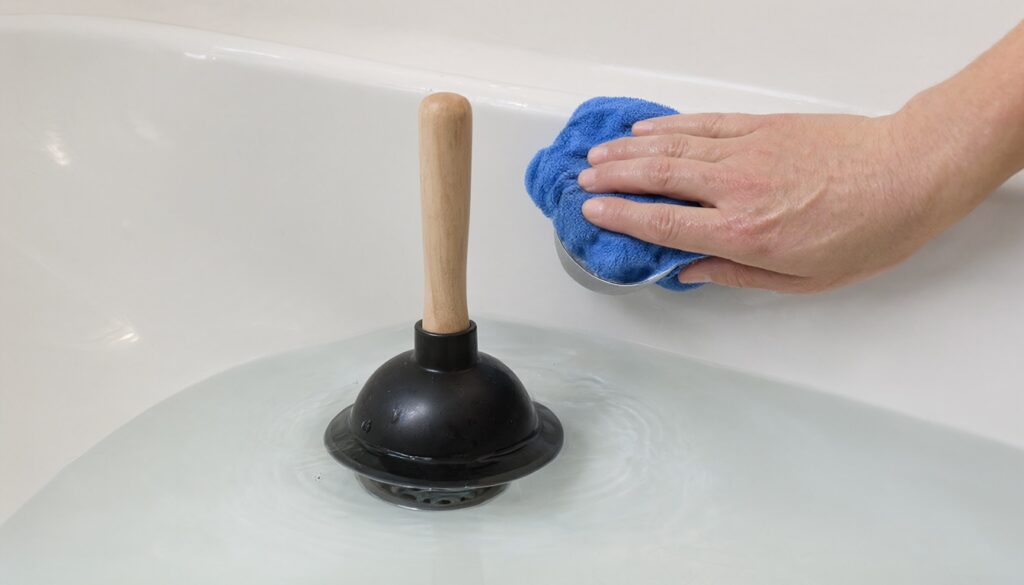
Step 5: Plunge with the overflow covered
If hair removal didn’t do it, the clog is further down. Put a few inches of water in the tub so the plunger cup is covered. Then press a wet rag firmly over the overflow opening. Without the rag, the plunger just pushes air out of the overflow instead of pushing on the clog. Plunge hard 10 to 15 times, pull the plunger off, and see if the water drains away.
Step 6: Snake the drain through the overflow
For a clog in the trap, a small hand auger works better than a plunger. Feed it through the overflow opening, not the drain. That route goes straight down to the trap with no crossbars in the way. Turn the handle as you push, and when you feel resistance, crank through it and then pull the cable back slowly. Run the shower afterward to test it, and clean the cable before you put it away.
If the snake goes in 3 to 4 feet and the drain is still slow, the clog is beyond the reach of household tools, or the problem is the vent or the main line.
Is your showerhead too powerful for the tub drain?
Tub-shower combinations usually drain through a 1½-inch trap. Stand-alone showers usually get a 2-inch drain. A smaller tub drain is fine with a standard showerhead. Federal rules cap showerheads at 2.5 gallons per minute, and the EPA’s WaterSense label goes further, at 2.0 gallons per minute or less.
Problems start when the shower setup adds more water. Common culprits are a large rain head plus a handheld running together, body sprays, or an older showerhead with its flow restrictor drilled out. A tub drain that’s only slightly narrowed by hair may still cope with 2.0 gallons per minute and then fall behind with more.
Use the bucket test above. If your shower puts out much more than 2.5 gallons per minute, clean the drain first, then think about a WaterSense showerhead. Lower flow also saves on water heating. Keep the showerhead clean too, because mineral buildup changes the spray pattern. Our guide to cleaning a brushed nickel shower head covers the gentle way to descale it.
Bathtub drain gurgling: could it be the vent?
Every drain is connected to a vent pipe that comes out through the roof. It lets air into the pipes so water flows smoothly. If leaves, a bird’s nest or ice in winter block the vent, water drains slowly and the pipe pulls air in through the nearest trap instead. That’s the gurgle you hear.
Signs that point to the vent rather than a clog:
- Gurgling or glugging from the tub, or from the sink when the tub drains
- A sewer smell in the bathroom (the gurgling can pull the water out of a trap)
- Several fixtures draining slowly, even after you clean the tub drain
- A toilet water level that rises and falls when another drain is running
You can look at the vent opening from the roof and run a garden hose into it, but that means working on a ladder and roof. If you’re not comfortable up there, a plumber can clear the vent and confirm it’s the cause. Don’t put chemical drain cleaners down a vent.
When a slow tub drain means a bigger problem
Call a plumber rather than doing more DIY work if:
- Water comes up into the tub when you flush the toilet or the washing machine drains. That’s a main-line backup. The tub is often the lowest drain in the house, so sewage can come up there first.
- Several drains are slow at the same time, especially downstairs.
- The tub was slow from the day it was installed. Drain pipes need a steady downhill slope, typically ¼ inch per foot for small drains, and a pipe that’s too flat or sags in the middle collects sludge.
- You’ve cleared the drain and it’s slow again within a few weeks.
- You’ve used a chemical drain cleaner and the drain is still blocked. Tell the plumber what you used, because the chemicals can still be in the standing water.
Older houses with cast-iron or clay lines and big trees nearby are most likely to have main-line trouble. A plumber can run a camera through the line to see what’s wrong before cutting into anything.
Are chemical drain cleaners safe for a slow tub drain?
They’re the last thing to try, not the first. Caustic and acid drain openers can burn skin and eyes, and they’re dangerous if they splash back out of a drain that’s fully blocked. Poison Control advises wearing goggles and rubber gloves, pouring slowly and close to the drain, and never mixing a drain cleaner with other products. It also warns that mixing bleach with acid or ammonia cleaners releases toxic gas.
A few rules if you do use one:
- Follow the label exactly, and only use a product rated for tubs and your pipe type.
- Never plunge or snake a drain that has chemical cleaner in it, because it can splash up.
- Don’t pour a second, different product on top of the first.
- Keep children and pets out of the bathroom until it’s rinsed through.
Baking soda followed by vinegar is safe, and it can help with smells and light film, but it won’t dissolve a mat of hair. Hot tap water is fine for flushing. Skip boiling water if you have an acrylic or fiberglass tub or plastic pipes. For the soap scum on the tub walls, our guide to cleaning shower tiles without scrubbing has a gentler approach.
How to keep a tub drain from slowing down again
- Use a hair catcher. A mesh or silicone hair catcher over the drain stops most hair before it gets in. Clean it after every shower or two, or it becomes the clog.
- Clean the stopper every month or two. Pull it out and wipe it off before hair builds up. It takes a couple of minutes.
- Brush long hair before you shower. Loose hair comes out on the brush instead of in the drain.
- Flush with hot water. Running the hottest tap water for a minute after a shower helps move soap film along.
- Watch the early sign. If water starts pooling around your feet again, clean the stopper that week, before it turns into a full clog.
For other drains in the house, see our guide on how to unclog drain pipes yourself. If it’s the toilet that’s backing up, see three ways to unclog a toilet.
FAQ
Why does my tub fill up with water when I shower?
The drain can’t carry the water away as fast as the showerhead puts it out. Usually that’s a partial hair clog at the stopper, or a stopper that doesn’t open fully. Clean the stopper and the drain opening first. If it still fills up, measure the showerhead flow and look for a deeper clog.
Why does my bath drain fine but not when I shower?
A full bath has 10 to 12 inches of water pushing down on the drain, which forces water through a partial clog faster. A shower adds water steadily with almost no depth behind it, so even a small restriction shows up as a puddle. Both point to the same partial clog.
How long should a bathtub take to drain?
There’s no fixed standard, but a clean tub drain should empty steadily without gurgling, and it shouldn’t hold standing water while a normal showerhead is running. If water keeps rising during a shower, the drain needs attention.
Why does my bathtub gurgle when it drains?
Gurgling means air is being pulled through the water in a trap. A partial clog can cause it, but gurgling together with slow drains in several fixtures or a sewer smell points to a blocked vent pipe or a main-line problem. Those are jobs for a plumber.