
Hard water stains on shower glass are mineral deposits, mostly calcium and magnesium, left behind when water dries on the door. How to remove them depends on how bad they are. Fresh spots wipe off with warm vinegar. Built-up limescale needs a stronger acid and some patience. Permanent etching, where the glass surface itself is damaged, can’t be cleaned off at all. Work up from the gentlest method, stop as soon as the glass is clear, and learn the squeegee habit so the spots don’t come back.
Which kind of hard water stain do you have?
Three different problems get called “hard water on shower doors,” and the fix is different for each. Figuring out which you have first saves you from scrubbing something that can’t be scrubbed away.
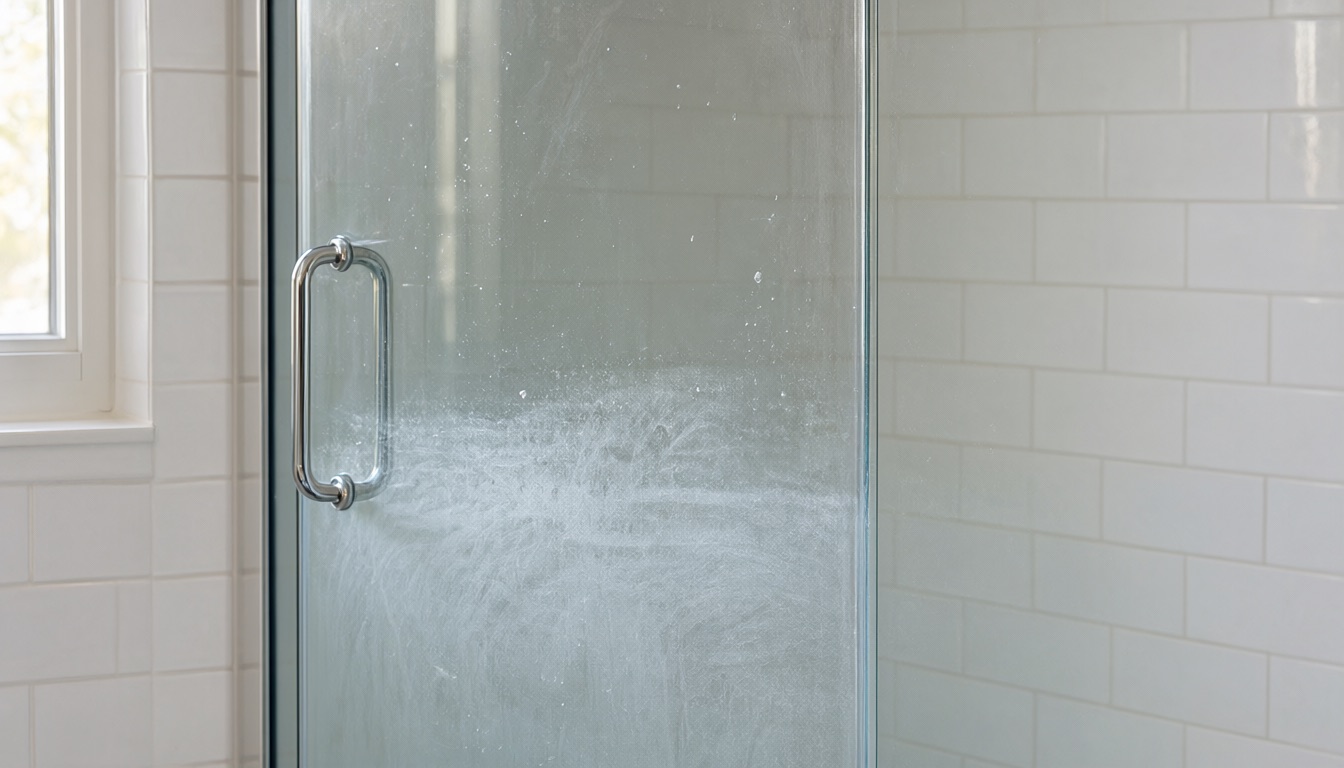
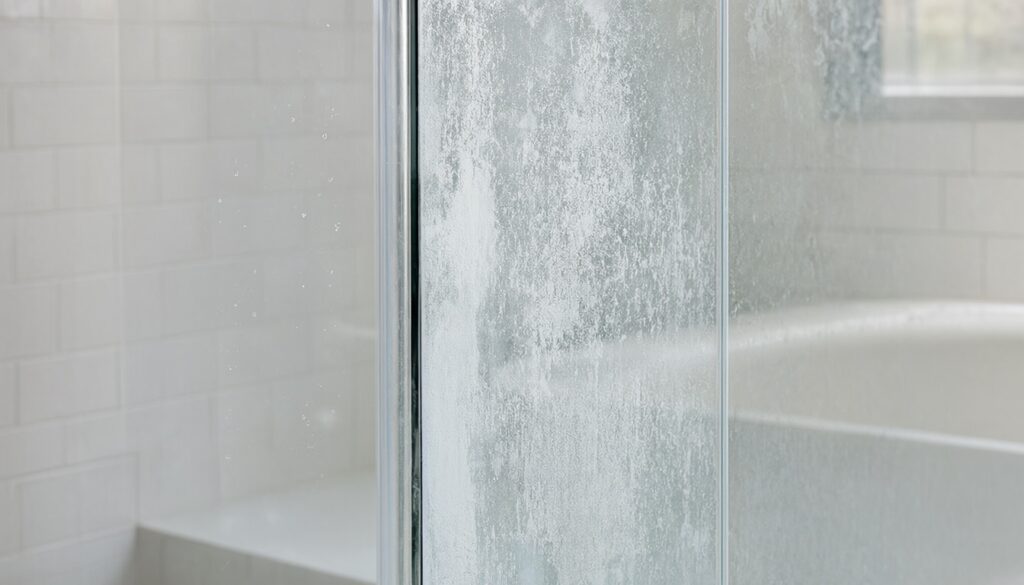
- Fresh spots. Small, separate white dots or drip trails, mostly on the lower half of the door. They feel slightly rough and wipe off easily.
- Built-up limescale. A chalky, cloudy film or crust that covers whole areas, feels gritty, and comes back fast after a wipe. This is mineral that has layered up over months.
- Etching. The mineral has eaten into the glass, leaving a permanent frosted look. The surface is smooth to the touch, and the haze stays after a proper acid treatment.
The wet-glass test (and a backup test)
Wet the glass with plain water and look at it from a low angle with the bathroom light on. Mineral deposits are a surface layer: they stay visible as white spots or film on the wet glass and feel gritty when you run a fingernail across them. Etched glass tends to look more even, hazy and smooth, and the cloudiness is built into the surface rather than sitting on it.
That test is a rule of thumb, so confirm it. Pick a spot, soak it with warm vinegar for 10 to 15 minutes (see Step 1 below), and wipe. If the spot clears, it was deposit. If it clears but the white haze comes back as the glass dries, or it never clears, you’re probably looking at etching, or a very thick layer that needs a stronger step. If the haze survives the citric acid or descaler step as well, treat it as etching.
Why does hard water leave stains on shower glass?
Hard water carries dissolved calcium and magnesium. The U.S. Geological Survey rates water as soft up to 60 mg/L of hardness, moderately hard at 61 to 120, hard at 121 to 180 and very hard above 180. When a droplet dries on the glass, the water leaves and the minerals stay. Each shower adds another layer, and soap scum helps it stick. Your utility’s annual water quality report, or a cheap test strip, tells you where your water falls.
The longer deposits sit, the harder they are to remove. Over a long time, minerals can bond to and roughen the glass surface, which is how a removable film turns into etching. That’s why the best time to clean limescale on shower glass is as soon as you see it.
Before you start: quick safety and prep
- Never mix bleach with vinegar or any other acid. The CDC’s published report on chlorine gas toxicity says that when bleach (sodium hypochlorite) meets an acid, chlorine gas is released, and its guidance is not to mix bleach with cleaners containing acids. Bleach and ammonia is a separate hazard that produces chloramine gases. Don’t use any other cleaner in the shower until you’ve rinsed out the last one.
- Open the bathroom window or run the fan, wear rubber gloves, and wear eye protection when you spray overhead.
- Check what’s around the glass. Vinegar and other acids can dull and etch natural stone such as marble, travertine and limestone, and can mark some metal finishes and rubber seals. Cover the stone with a towel and rinse any drips right away.
- Find out whether your glass has an “easy-clean” or protective coating. Check the paperwork or ask the installer. Acids and abrasives can wear a coating off, so follow the maker’s care instructions, which often call for just mild soap and a squeegee.
The method ladder: remove shower glass water stains from gentle to strong
Start at the top and move down only if the stain is still there. Skipping straight to a razor or a harsh descaler is how glass gets scratched.
Step 1: Warm vinegar, held in place (fresh spots and light film)
White vinegar is a mild acid that dissolves calcium deposits. The trick on vertical glass is keeping it in contact long enough, because a spray alone runs straight off.
- Warm equal parts white vinegar and water until hot to the touch but not boiling. A short time in the microwave works, and take care with the hot bottle or bowl.
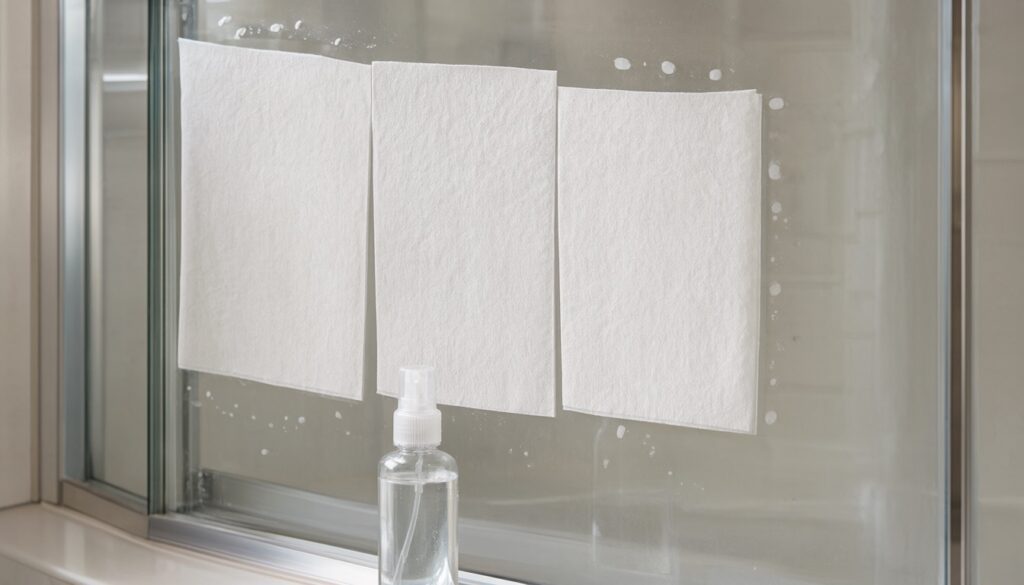
- Soak paper towels or a microfiber cloth in the mixture and press them flat onto the glass so they cling. Spray the towels again if they start to dry.
- Leave them for 15 to 30 minutes.
- Take the towels off, scrub gently with a non-scratch sponge, rinse with clean water and squeegee dry.
If you want a general vinegar glass routine for other windows too, see our guide to cleaning windows with vinegar. Plain vinegar often does little on deposits that have built up for months, so don’t be discouraged if it only softens them.
Step 2: Baking soda paste (light scrubbing power)
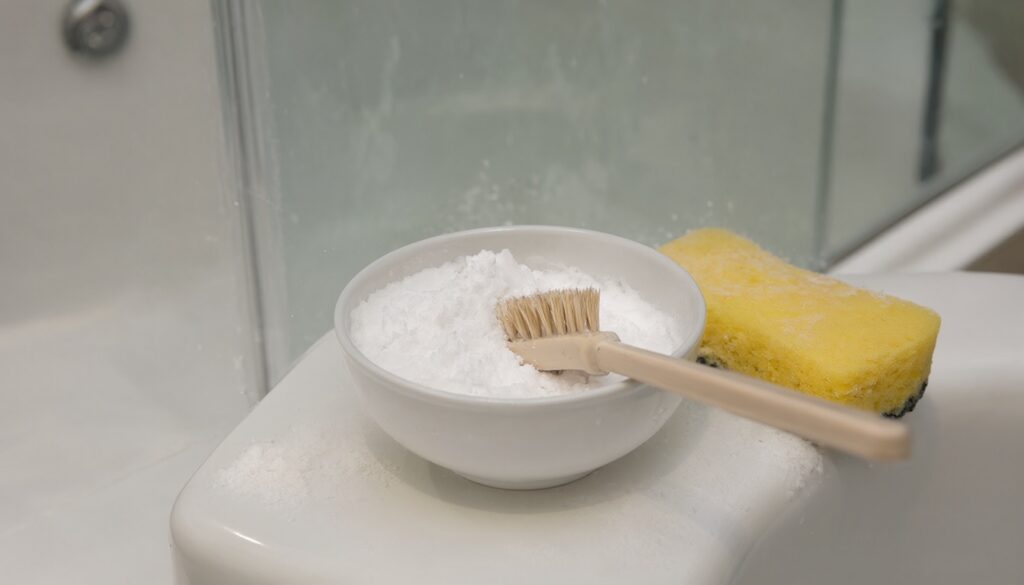
Baking soda is a very mild abrasive, which helps on stuck-on spots after the vinegar has loosened them. Mix it with a little water into a spreadable paste, rub it onto the damp glass with a soft sponge or soft-bristle brush in small circles, and rinse well. Don’t spray vinegar over a thick layer of baking soda and expect more power. They neutralize each other, so use them one after the other with a rinse between.
Step 3: Citric acid (for built-up limescale)
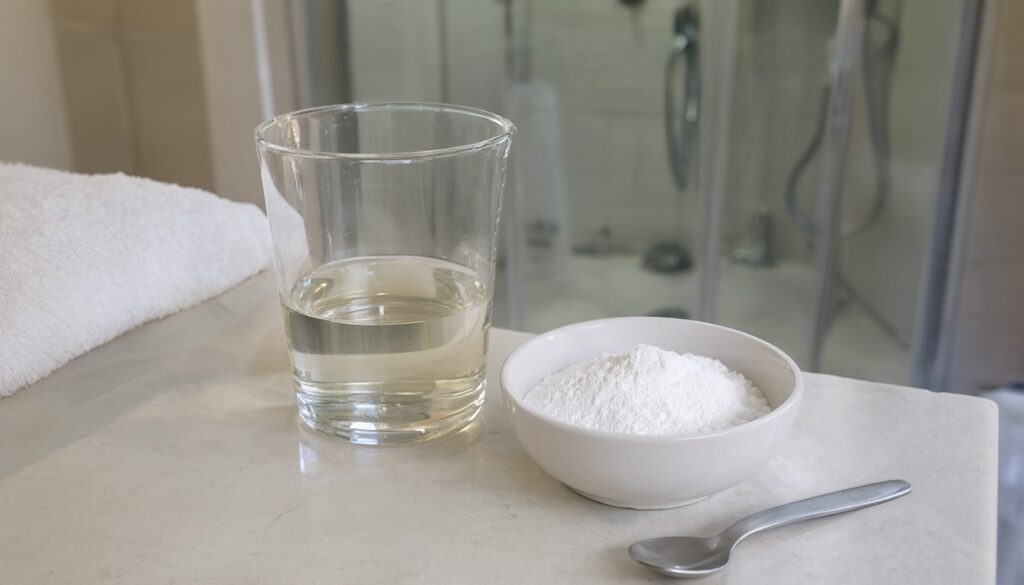
Citric acid powder, sold in the canning aisle and with cleaning supplies, is a stronger descaler than vinegar and has no strong smell. Dissolve a couple of tablespoons in a cup of hot water, apply it with a cloth or a spray bottle the same way as the vinegar (towels to hold it on), and let it work for 15 to 30 minutes. Rinse thoroughly and dry. As with any acid, keep it off natural stone and off coated glass.
Step 4: A commercial hard water or limescale remover
If the glass is still cloudy, a cleaner made for limescale and hard water deposits is the next step. Most are acid-based (some are paste-style glass polishes). Read the label for what surfaces it’s safe on, ventilate, wear gloves, rinse thoroughly, and never combine it with bleach. Do a small test spot first. Stop here if the glass clears. Our guide to cleaning shower tiles without scrubbing covers the walls next to the glass.
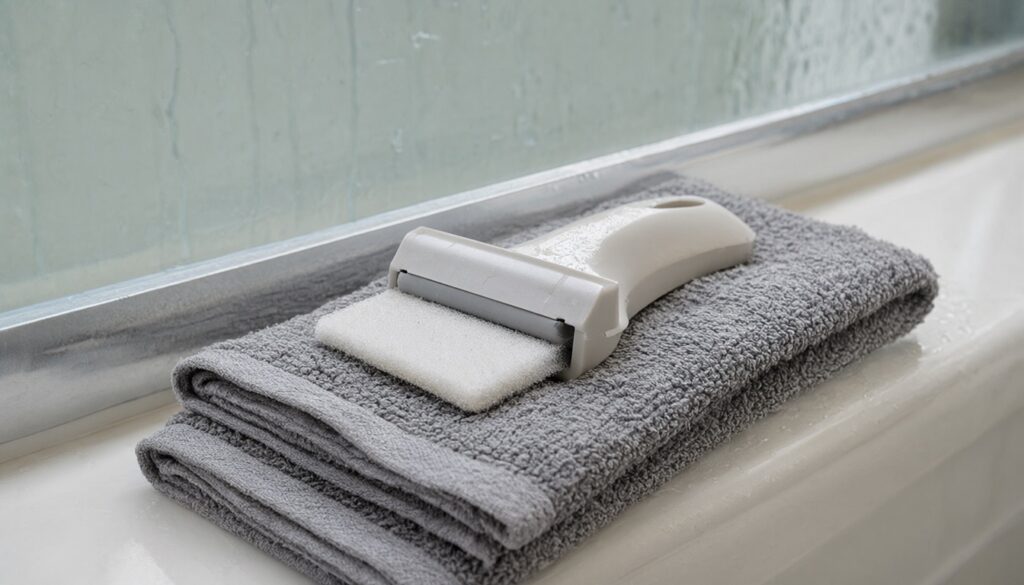
Step 5: A fine-grade pad or razor scraper (glass only, last resort)
For stubborn crust that survived the acids, a fine-grade non-scratch pad or a single-edge razor scraper can lift what’s left. This works only on plain glass.
- Keep the glass soaked with water or glass cleaner so the blade glides.
- Use a new blade, hold it at a low angle (roughly 30 degrees) and push in one direction with light pressure. Don’t saw back and forth.
- Try a hidden corner first. Any grit under the blade will scratch.
- Never use it on coated glass, plastic or acrylic panels, metal frames or seals.
What not to use on shower glass
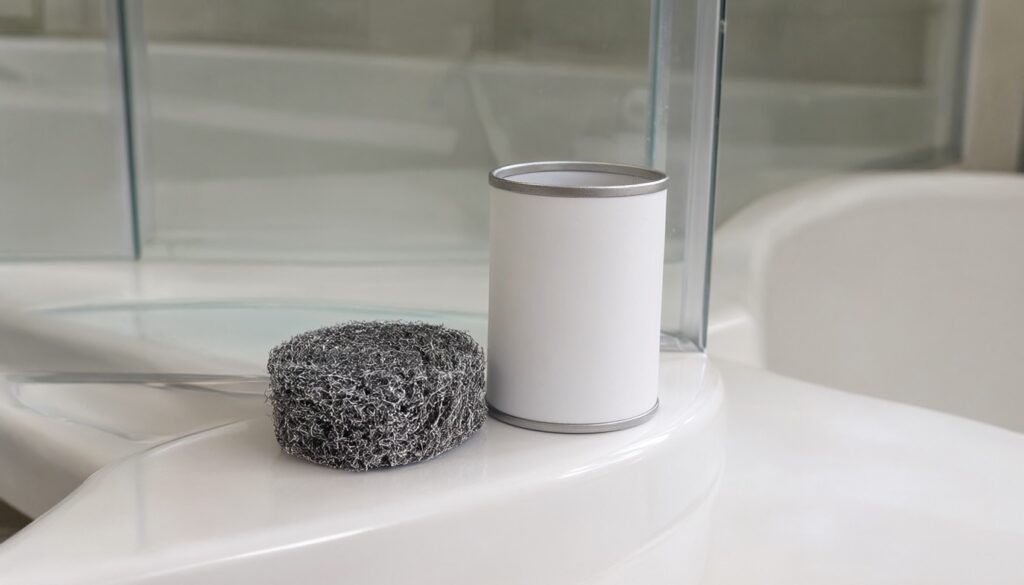
- Abrasive scouring powders and steel wool. They scratch glass, and scratches collect minerals faster than smooth glass does. A forum commenter swears by soapy steel wool, but it’s the quickest way to turn a cleaning job into permanent damage.
- Bleach mixed with vinegar, citric acid, a descaler or ammonia. It can release toxic gas, as covered above.
- Acids on natural stone next to the door, such as a marble sill or travertine curb.
- Acids and abrasives on coated “easy-clean” glass. You can strip the coating and be left with uneven spots.
- Sandpaper or power sanders as a regular fix. Glass specialists treat mechanical removal as a last resort, because it can change how the glass looks.
Comparison: which method for which stain?
| Method | Best for | Time | Cautions |
|---|---|---|---|
| Warm vinegar and water, held on with towels | Fresh spots, light film | 15 to 30 minutes, plus rinsing | Keep off natural stone; never mix with bleach |
| Baking soda paste | Loosened spots, light scrubbing | 10 to 15 minutes | Mildly abrasive; use a soft sponge; rinse fully |
| Citric acid solution | Built-up limescale | 15 to 30 minutes | Acid; no stone or coated glass; rinse well |
| Commercial limescale remover | Heavy cloudy film | Per label, often 5 to 15 minutes | Ventilate, gloves; check surface compatibility; never mix products |
| Fine pad or razor scraper | Crust left after acids | 10 to 20 minutes | Plain glass only; wet blade; scratches if gritty |
| Glass specialist restoration or replacement | Etching | Appointment, then a few hours to days | Cost; see below |
The times are rules of thumb, not tested results. Always follow the product label.
How to keep hard water off shower doors for good
Cleaning only resets the clock. Prevention is mostly about not letting water dry on the glass.
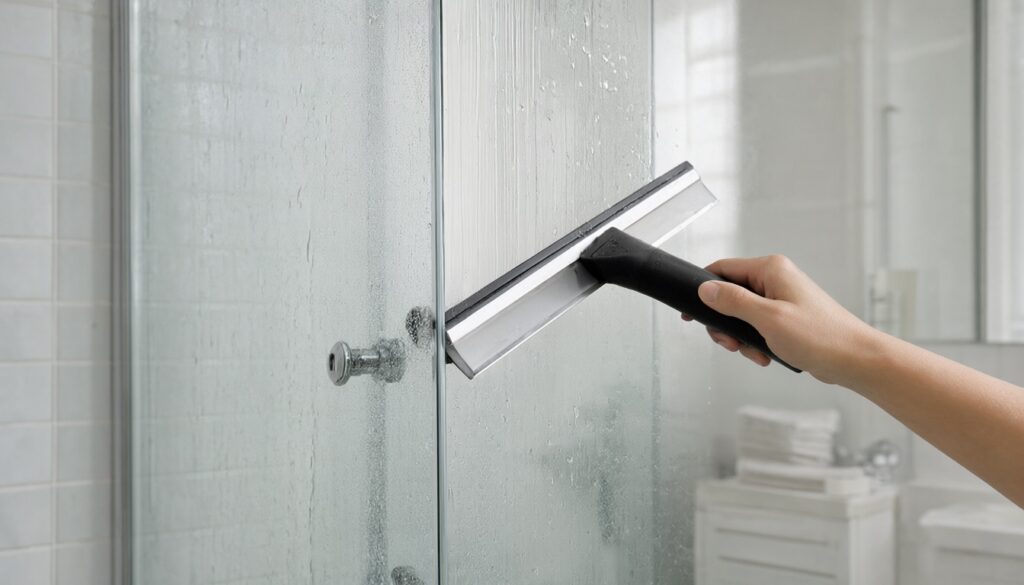
- Squeegee after every shower. It takes 30 seconds and is the single most repeated tip from cleaning pros and glass companies. Keep the squeegee on a hook inside the shower so you actually use it.
- Use a hard-water-specific cleaner weekly instead of a general glass spray, and wipe the lower half of the glass where water pools.
- Seal or coat the glass. A glass sealant, a water-repellent treatment or a factory protective coating makes water bead and slide off. Coatings wear down and need reapplying or upkeep per the maker’s instructions. This Old House lists a water-spot coating as an add-on when you order a new door, at about $4 to $20 per square foot.
- Treat the water, not just the glass. A whole-house water softener reduces the minerals that cause the spots at the source. A showerhead filter is cheaper but is honest about its limits: many filters target chlorine, not hardness, so check that the product says it reduces hardness or scale, and expect less effect than a softener.
- Run the fan and leave the door open so the glass dries faster.
Don’t forget what’s below the glass. Mineral gunk and mildew collect in the bottom track, and our post on shower door track black gunk covers that separately. A showerhead with scale on it sprays minerals everywhere, so see how to clean a brushed nickel shower head.
When to call a pro or replace the glass
Call a glass specialist, or consider replacing the glass, when:
- The haze stays after the vinegar, citric acid and a commercial remover, or it comes back immediately after cleaning. That points to etching.
- You can feel pitting or see a frosted look that doesn’t change when wet.
- The glass is coated and you aren’t sure what’s safe.
- The door is cracked, chipped, loose on its hinges or leaking.
Some glass shops offer restoration or polishing for light etching, but results vary and it isn’t always possible.
If replacement is the answer, typical US installed costs per This Old House’s cost guide are about $600 to $1,200 for a framed door and $1,100 to $5,000 for a frameless one, with most door installs falling between roughly $530 and $1,390. A full framed or sliding door replacement is about $500 to $1,000 according to Inch Calculator. Size, glass thickness, hardware and local labor all move the price, so get a couple of local quotes. When you order, ask about a factory water-spot coating, and treat the new glass well from day one.
FAQ
Does vinegar really remove hard water stains from shower glass?
On fresh spots and light film, yes, as long as it stays in contact with the glass. Heating it and holding it on with paper towels helps. On months of buildup it often isn’t enough, and you’ll need citric acid or a commercial limescale remover.
Can hard water permanently damage shower glass?
Yes. If minerals sit for a long time, they can etch the glass surface, leaving a permanent frosted look that cleaning won’t fix. Catching deposits early and drying the glass after showers is the best protection.
Is it safe to use a razor blade on shower glass?
On plain, uncoated glass, with a wet surface, a new blade and a low angle, usually yes. Never use one on coated glass, plastic panels or near seals, and test a hidden corner first.
Will a water softener stop hard water spots on glass?
It reduces them a lot because the minerals are removed before the water reaches the shower, but drying water can still leave some residue, so squeegeeing still helps. A showerhead filter is a smaller step that varies by product.