
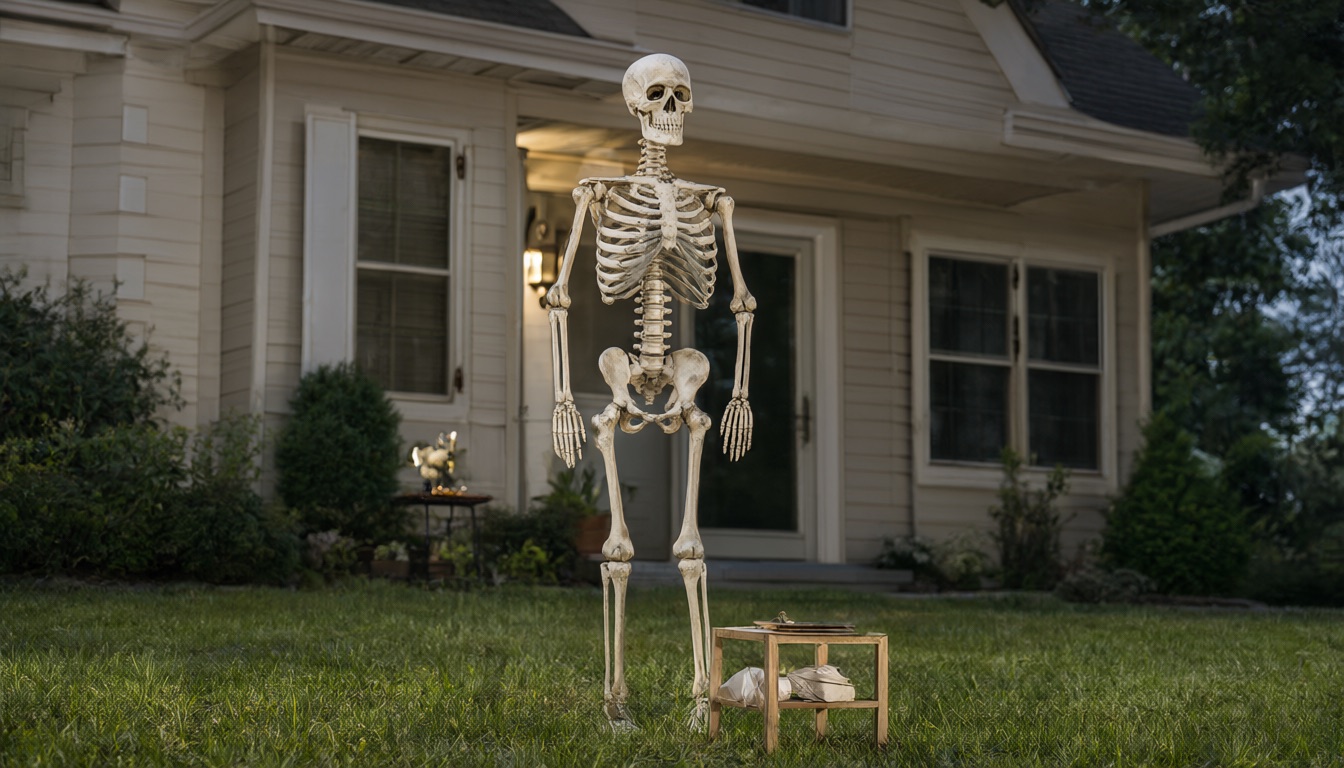
A 12-foot skeleton gets noticed from the street the moment it goes up. Most of the fun comes from what you put around it, though. A pose, a few props and some good lighting turn a big plastic figure into a scene people slow down to look at. Below are staging ideas first, then the practical parts: setup, anchoring it against wind, lighting it safely and storing it until next year.
What are the best ways to stage a 12-foot skeleton?
Start with a story. A giant skeleton just standing in the lawn looks like a store display. One doing something looks like a scene. Pick one idea, pose the arms and head to match, and add two or three props that support it. Don’t scatter ten unrelated things around it.
Scene ideas that work with a standard pose
- The giant peeking over the house. Put it close to the front wall or a fence with the head tilted down and one hand resting on the roofline or gutter (just resting, never hanging any weight). From the street it looks like it’s checking who’s home.
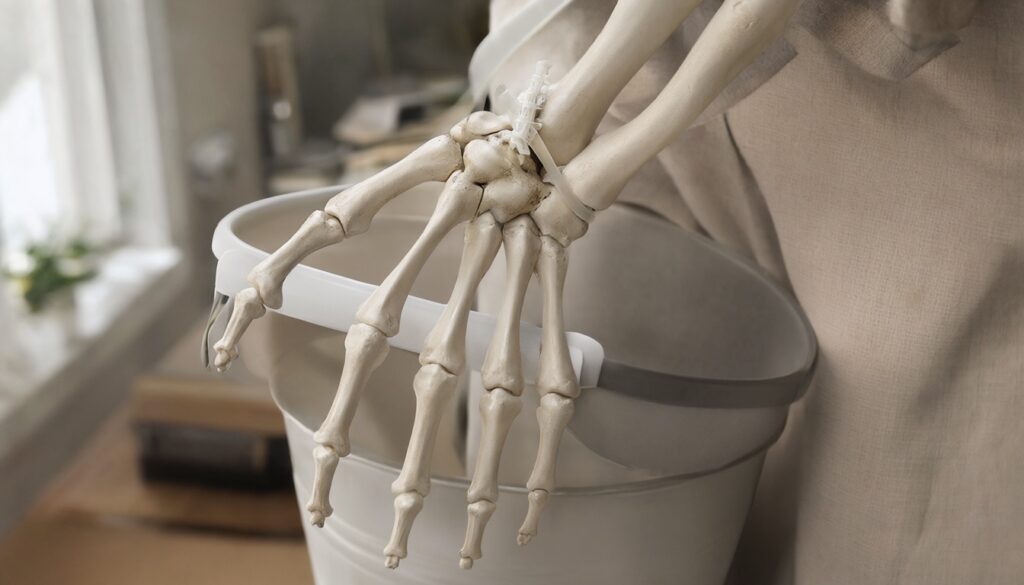
- Trick-or-treat greeter. Bend one arm forward and hang a large bucket or cauldron from the hand at kid height. Keep it to lightweight plastic so you’re not loading the joint.
- Gardener of the dead. Pose it leaning over a “grave plot” made from a few foam headstones, a mound of mulch and a rake or shovel propped in one hand.
- Fishing in the yard. Run a long pole from the hand to a kiddie pool or a tarp painted as a pond, with a smaller skeleton “catch” on the line.
- Giant and tiny. Stand a few small skeletons or skulls around its feet as if it’s walking a crowd of pets or kids. The size contrast makes 12 feet look even bigger.
- Harvest giant. Pair it with hay bales, corn stalks and a pile of pumpkins for a fall look that works from early October. A handmade DIY scarecrow next to it makes a fun “scarecrow failed” joke.
- Peekaboo behind a tree. Set it partly behind a large tree or shrub so only the skull, a shoulder and one hand show. This also gives it some wind shelter.
- Costumed giant. Add an oversized hat, a scarf, a cape made from a flat sheet or a dollar-store wig. Secure every piece with zip ties so it doesn’t turn into a sail.
Link it to your front door
The skeleton is the headline, but visitors walk up to the door. Carry one color or theme from the yard to the entry so the whole front reads as one display. Our Halloween front door decorations have ideas that pair well with a giant figure.
Where should you put a 12-foot skeleton in the yard?
Placement matters as much as the pose. Walk to the sidewalk and across the street before you commit to a spot.
- Visible but not in the way. Keep it well clear of the driveway, sidewalk and front path so a fall can’t hit a car or a person. A good rule is to leave a clear zone at least as wide as the figure is tall on every side it could tip toward.
- Away from power lines. Never set it up where it could fall into overhead lines, and look up before you raise it.
- Firm, level ground. Lawn with decent soil holds anchors best. Soft, soggy or sandy spots need extra weight.
- A backdrop helps. A wall, hedge or the side of the house behind it gives the figure contrast at night and blocks some wind.
How do you set up a 12-foot skeleton?
Check the manual for your exact model, because hardware differs between brands. The general process looks like this.
What you need
- Two adult helpers (three is easier)
- The figure’s base, stakes and any included tethers
- Three or four heavy-duty spiral ground anchors (for lawn) or sandbags (for hard surfaces)
- Outdoor-rated rope or coated steel cable, plus clips or turnbuckles to tension it
- Zip ties, a rubber mallet and a stepladder
- Gloves and a flashlight if you’re finishing after dark
Steps
- Pick a calm, dry day. Raising a 12-foot figure in a breeze is how frames get bent and people get hurt.
- Assemble on the ground. Lay the pieces out on a tarp, connect the legs, torso and arms, and check that every pin and bolt is fully seated.
- Fix the base first. Position the base where the figure will stand and stake it down before you raise anything.
- Raise it with two people. One person lifts from the upper body while the other guides the feet into the base. Don’t try this alone.
- Attach the tethers right away. Don’t leave it standing “for a minute” without lines on it.
- Pose last. Adjust the arms and head once the figure is secure. Use the stepladder on level ground, and have a helper hold it.
[REVIEWER: add a first-hand tip / your result here]
How do you keep a 12-foot skeleton from blowing over?
Wind is the main risk with a giant skeleton. The figure is tall with a fairly small footprint, and the base that comes in the box is usually meant for calm weather. Plan to add your own anchoring from day one.
- Use three or four guy lines. Tie them high on the figure (around the spine or upper rib cage, not the thin arms). Run them out at an angle to anchors spaced evenly around it, like a tent.
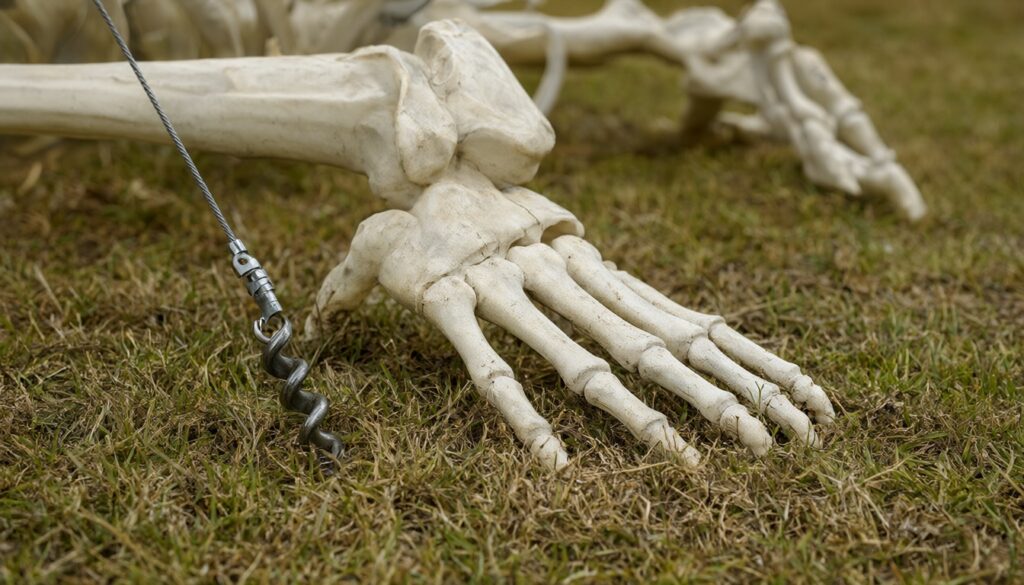
- Use spiral ground anchors, not just the included stakes. Screw them in until only the loop shows. In loose soil, go longer or add more.
- Tension lines snugly, not drum-tight. Turnbuckles make it easy to adjust. Over-tight lines can stress the plastic frame.
- Add weight on hard surfaces. On a patio or driveway where you can’t stake, use sandbags or concrete blocks on the base, and tie lines to something solid.
- Check weekly. Soil softens after rain. Walk around it once a week and re-tighten anything that’s slack.
- Take it down for storms. No home setup is built for severe wind. If a big storm or high-wind warning is forecast, lower it to the ground or bring it inside until it passes.
Safety note: A falling 12-foot figure can damage cars, windows and people. If you have any doubt about the ground or the weather, keep it lower, add another line, or skip the day.
How should you light a giant skeleton?
Most giant skeletons come with light-up eyes, but they don’t light the body. A little added lighting makes it read from the street after dark.
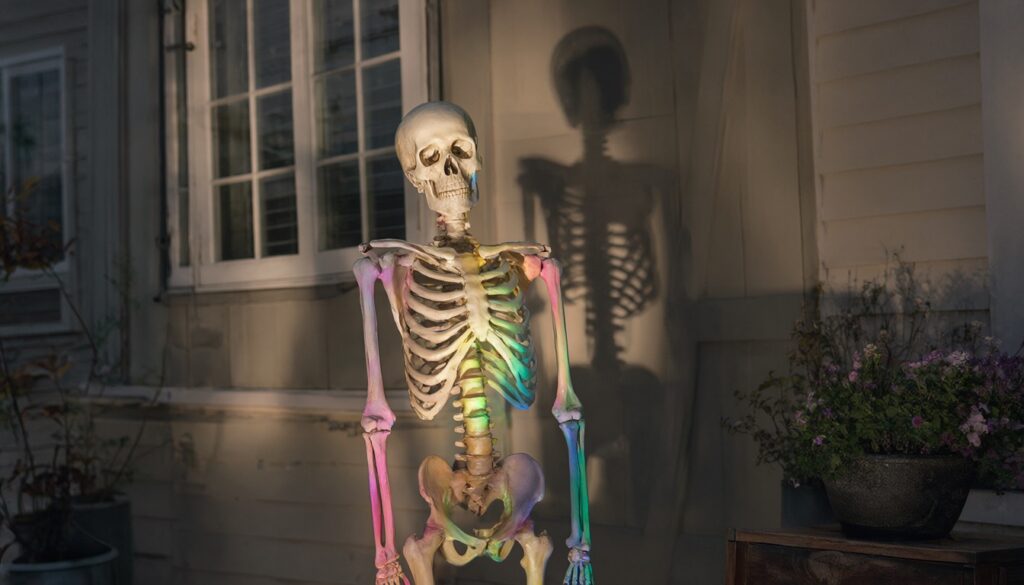
- Uplight from the front. One or two outdoor spotlights on the ground, aimed up, throw long shadows on the house. Purple, green or orange bulbs set the mood. Plain white looks eerie and bony.
- Backlight for a silhouette. A light behind the figure, aimed at the wall, outlines it in black.
- Light the props, not just the giant. A glowing cauldron, lanterns along the path or flameless candles on the grave plot add depth.
- Put it on a timer. A plug-in outdoor timer saves batteries and electricity, and keeps the yard dark at night.
Outdoor electrical safety
Use only lights and extension cords labeled for outdoor use. Plug them into a GFCI-protected outlet, and keep connections up off wet ground. Inspect cords for cracks or frayed spots before each season. The U.S. Consumer Product Safety Commission recommends not linking more than three sets of incandescent lights together. The NFPA also advises inspecting outdoor lights and cords before use. Route cords so nobody trips on them at night.
Can you use a 12-foot skeleton for Christmas and other holidays?
Yes. A lot of owners leave the base in and restyle the figure for the next season, which is part of the appeal.
- Fall harvest: straw hat, flannel shirt tied at the waist, pumpkins at its feet.
- Thanksgiving: a pilgrim-style hat and a paper “turkey” in its hand.
- Christmas: a Santa hat, a red scarf and a garland of lights wrapped down the spine. It pairs well with other outdoor Christmas decorations and a dressed front porch.
- Valentine’s Day: a giant cardboard heart held in both hands.
Check your local HOA or neighborhood rules if the figure will be up for months. Inspect the anchors at every change of costume.
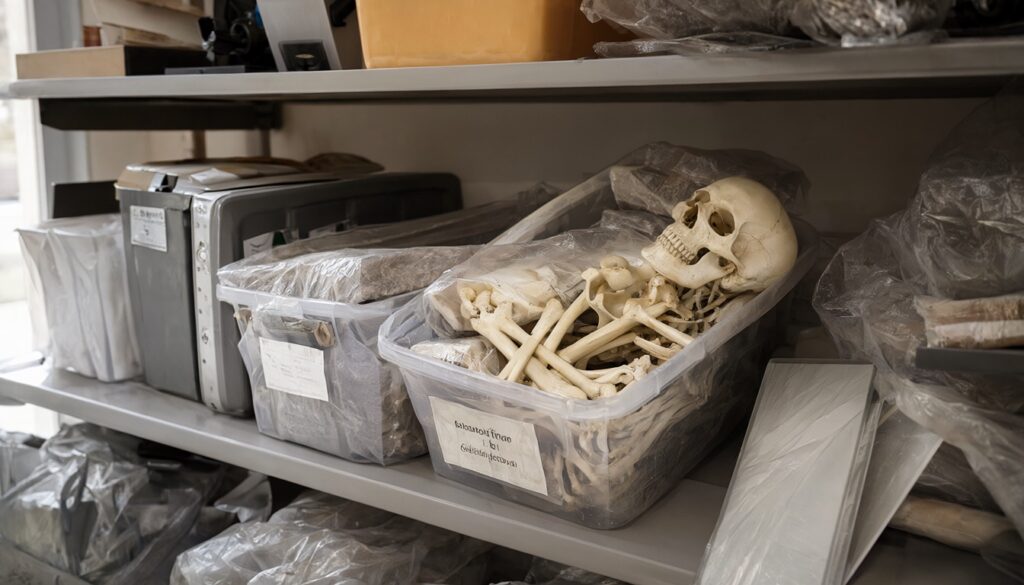
How do you store a 12-foot skeleton?
Storage is the part most people underestimate. The figure breaks down, but the rib cage and skull are bulky.
- Clean it first. Wipe it down with mild soap and water and let it dry fully, so dirt and moisture don’t sit on it for eleven months.
- Remove batteries. Take the batteries out of the eyes and any light-up parts to prevent corrosion.
- Disassemble in reverse. Lower it with two people, then take it apart on a tarp. Bag and label the pins, bolts and tethers together.
- Protect the big pieces. Wrap the skull and torso in old blankets or moving pads. Store limbs in long bins or a duffel.
- Choose a dry spot. A garage shelf, attic or shed works if it stays dry. Keep it out of direct sun, which can fade and weaken plastic over time.
- Store the anchors with it. Spiral anchors and lines are reusable, so keep them in the same bin for next year.
[REVIEWER: add a first-hand tip / your result here]
FAQ
How many people does it take to put up a 12-foot skeleton?
Plan on at least two adults to raise it, with a third person helpful for holding guy lines. Assembly on the ground can be done by one person, but lifting it upright shouldn’t be.
Can a 12-foot skeleton stay outside in rain?
Most are molded plastic made for outdoor use, so rain itself isn’t usually the problem. Soggy ground loosening the anchors is. Check the lines after heavy rain, and keep battery compartments and plug connections protected.
What do you put a 12-foot skeleton on if you don’t have a lawn?
On a driveway, patio or deck, use the base with sandbags or concrete blocks. Tie guy lines to solid points like a post, railing or heavy planter. Avoid tying to anything that could pull loose.
When should you take a 12-foot skeleton down?
Whenever strong wind or a storm is forecast, and at the end of the season once the weather turns. Lowering it for a day is much easier than repairing a bent frame.